THERE IS NO BETTER WEALTH THAN HAVING A GREATER HEALTH...! Online AYURVEDA Consultation | TRANSPARENCY | CONFIDENTIALITY | DIGNITY

Headache vs Migraine: Ayurvedic Difference, Symptoms, Causes & Natural Management
Understand the difference between headache and migraine through Ayurveda. Learn about Shiroroga, Ardhavabhedaka, triggers, warning signs, and personalized Ayurvedic care by Dr Ashok Rathod.
Admin
7/7/20263 min read
Namaste!
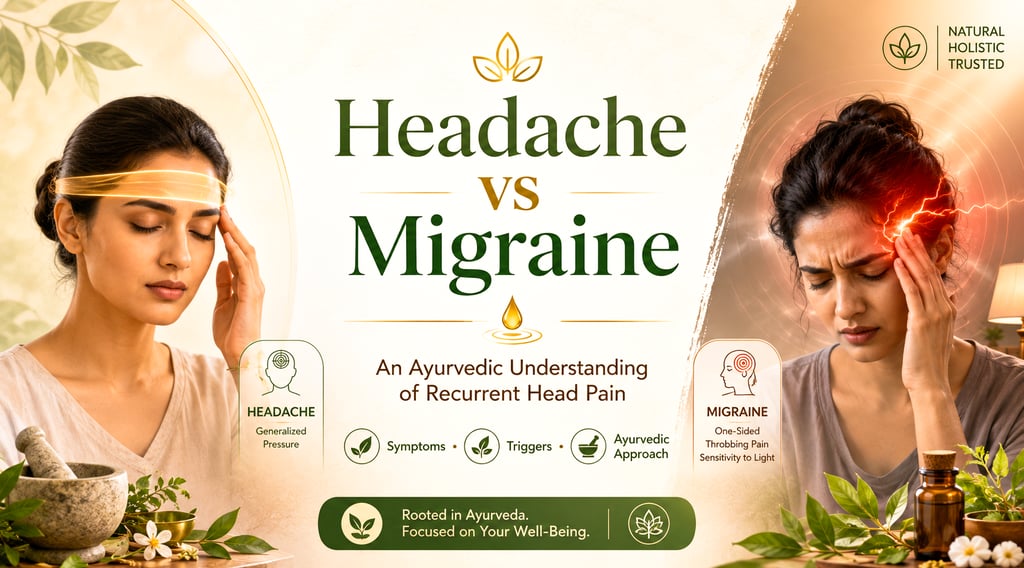
Head pain is one of the most common complaints in daily life. Many people casually say, “I have migraine,” whenever they get a headache. But every headache is not migraine. Understanding the difference between a simple headache and migraine is important because the causes, severity, triggers, and long-term management are different.
A common headache is usually mild to moderate. It may feel like heaviness, pressure, tightness, or a dull ache around the forehead, temples, back of the head, or both sides of the head. It is often related to stress, dehydration, lack of sleep, long screen exposure, eye strain, poor posture, skipped meals, acidity, constipation, or mental fatigue.
Migraine, on the other hand, is usually more intense and disabling. It may present as throbbing or pulsating pain, often on one side of the head. Many patients also experience nausea, vomiting, sensitivity to light, sensitivity to sound, disturbed sleep, fatigue, irritability, blurred vision, or inability to continue work. A migraine attack may last for a few hours to even three days, and in some people it keeps recurring again and again.
Headache vs Migraine: Key Differences
A simple headache usually causes dull pressure or tightness. Migraine usually causes throbbing, pulsating, or splitting pain.
A headache may affect both sides of the head. Migraine often affects one side, though it may also shift sides or involve the whole head in some patients.
Nausea and vomiting are uncommon in ordinary headaches, but they are common in migraine.
Light and sound sensitivity are usually absent in simple headaches, but they are very common in migraine.
A normal headache may improve with rest, hydration, food, sleep, or correction of the trigger. Migraine usually requires deeper evaluation of triggers, digestion, sleep rhythm, hormones, stress, food habits, and lifestyle.
Ayurvedic View: Shiroroga and Ardhavabhedaka
Ayurveda explains disorders of the head under Shiroroga. Migraine-like one-sided severe headache closely resembles Ardhavabhedaka, a classical condition where pain affects one half of the head with a splitting, piercing, or severe pattern.
1. Charaka Samhita, Sutrasthana 17/8–11
“सन्धारणाद्दिवास्वप्नाद्रात्रौ जागरणान्मदात्।
उच्चैर्भाष्यादवश्यायात् प्राग्वातादतिमैथुनात्॥
वातादयः प्रकुप्यन्ति शिरस्यस्रं च दुष्यति।
ततः शिरसि जायन्ते रोगा विविधलक्षणाः॥”
Meaning: Suppression of natural urges, day sleep, night awakening, mental strain, exposure to cold wind, unsuitable food, improper digestion, and other wrong habits disturb doshas and blood circulation in the head, leading to different types of head disorders.
This is very relevant today. Irregular sleep, excessive screen time, skipped meals, mental stress, constipation, acidity, and poor routine are common triggers in many headache and migraine patients.
2. Charaka Samhita, Sutrasthana 17/13–14
“अर्धावभेदको वा स्यात् सर्वं वा रुज्यते शिरः।
प्रतिश्यामुखनासाक्षिकर्णरोगशिरोभ्रमाः॥”
Meaning: Head disorders may appear as pain in half of the head, pain in the whole head, sinus-related complaints, eye-ear-nose involvement, vertigo, and other associated conditions.
This verse beautifully shows that Ayurveda does not look at headache only as “pain.” It studies the entire head region, including nose, eyes, ears, sinuses, neck, digestion, circulation, and dosha imbalance.
3. Ashtanga Hridaya, Sutrasthana 20/1
“ऊर्ध्वजत्रुविकारेषु विशेषान्नस्यमिष्यते।
नासा हि शिरसो द्वारं तेन तद्व्याप्य हन्ति तान्॥”
Meaning: In diseases above the clavicle, Nasya is especially indicated because the nose is considered the gateway to the head.
This does not mean everyone should put oils or medicines into the nose on their own. Nasya should be selected carefully by an experienced Ayurveda physician after understanding the patient’s prakriti, dosha involvement, age, strength, season, digestion, and disease stage.
Why Do Headaches and Migraine Keep Coming Back?
From an Ayurvedic perspective, recurrent headache or migraine may be linked with Vata aggravation, Pitta heat, Kapha blockage, Ama formation, disturbed digestion, poor sleep, stress, hormonal fluctuation, sinus congestion, constipation, neck stiffness, or improper food combinations.
Common modern triggers include late nights, fasting, excess tea or coffee, dehydration, bright light, loud noise, strong smells, processed food, cheese, chocolate, alcohol, long screen exposure, emotional stress, and irregular meal timing.
When Should You Not Ignore Head Pain?
Please seek urgent medical care if headache is sudden and severe, associated with weakness, facial deviation, confusion, vision loss, repeated vomiting, fever, neck stiffness, head injury, fainting, or a new headache after age 50. Ayurveda is very helpful in long-term personalized management, but emergency warning signs must never be ignored.
Ayurvedic Management Approach
Ayurvedic management focuses on finding the root cause. The plan may include diet correction, sleep routine, hydration, bowel correction, stress regulation, eye and screen care, dosha-specific herbs, suitable Nasya, Shirodhara, local therapies, Panchakarma when required, and long-term prevention of triggers.
Instead of repeatedly depending only on painkillers, a personalized Ayurvedic plan helps identify why the headache or migraine is recurring.
If you suffer from frequent headache, one-sided throbbing pain, nausea, light sensitivity, sinus-associated headache, acidity-related headache, stress headache, or sleep-related migraine, book an online Ayurveda consultation with Dr Ashok Rathod, M.D. Ayurveda at www.ayurvedabhishaj.com for a personalized diet, lifestyle, and Ayurvedic management plan.
Ayurveda Bhishaj
Specialized Ayurvedic Doctor with 20+ years experience.
Contact :
Email: ayurvedadoctor@ayurvedabhishaj.com
© 2024. All rights reserved.